
Menu
Writing Style Guide
Writing goals and principles
Welcome!
Presenting written information in a precise and consistent way enhances an organisation’s professionalism and credibility. This is particularly important for Emmanuel College, where sound grammar, formatting and use of plain English are expected of an organisation operating in the education sphere.
As part of the Emmanuel College brand, this writing style guide has been compiled to help authors who create material on behalf of the College to feel confident that their writing complies with these high standards and is error free. It offers advice on general principles and guidance for the use of specific terms.
An overarching rule for authors is to consider the needs of their readers. That is, how can we communicate in a way that makes reading—and therefore comprehension—of our writing as effortless as possible?
Authors, editors and proofreaders are encouraged to refer to this guide regularly.
References
At Emmanuel College, we use Plain English and reference Australian Government Style Manual with some modifications, as described herein. We follow Macquarie Dictionary for spelling.
Where relevant, Emmanuel College also aligns with The University of Queensland’s written style guide. However, Emmanuel College style conventions take precedence.
Academic and research writing may require different referencing styles to be followed, and authors should consult relevant reference points as necessary.
Tone of voice
We express Emmanuel College's personality every time we communicate; whether we're talking to future students at a school visit, or parents at our Open Day, sending residents emails, inviting alumni to events or interacting with our audiences online.
It's not about what we say, but rather the way we say it and the impression it makes on anyone who sees us, hears us and/or reads about us.
We use tone of voice to build our brand personality.
At Emmanuel College we want to build a personality that is authentic and down-to-earth.


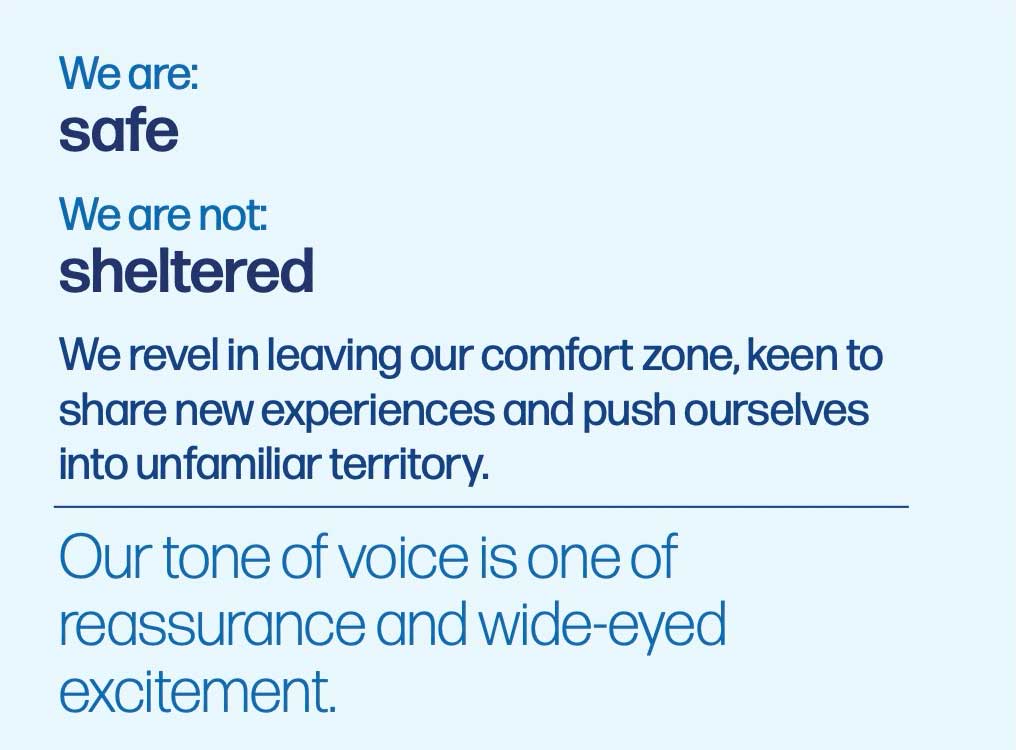
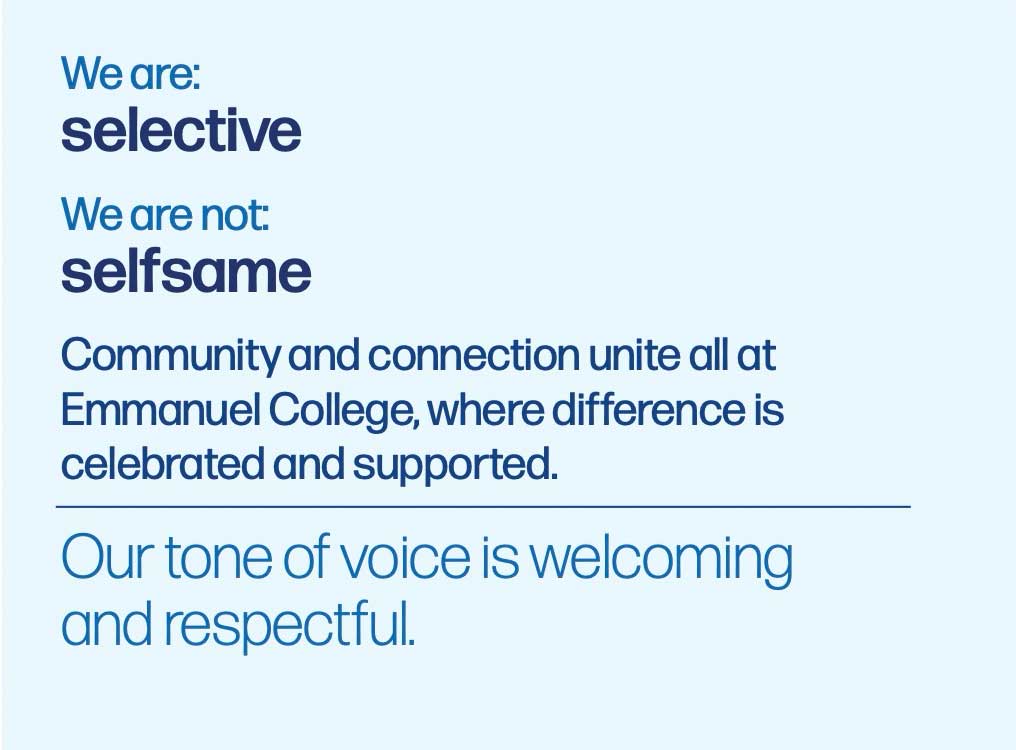

How do we put our tone of voice into practice?
Much like the value we put into students' curiosity, so we should remain open and genuine in our tone of voice, emphasising warmth, optimism and excitement.
For the purposes of this style guide, the following tips have been created for writers:
- Emphasise warmth, optimism and excitement
- Keep language uncomplicated, avoid jargon and reflect the College’s transparent, friendly disposition
- Reassure and carefully explain the unique workings of life at Emmanuel
- Write with empathy and benevolence; elaborate on vital details
- Honour our past and share the quirks and traditions that set our College apart with respect and care
- Use the student voice for authenticity
Authors should also consider the following general tone and style guidelines and refer to them when writing on behalf of the College.
Our tone should be
Approachable
Keep language uncomplicated. Write in plain English and avoid jargon and unexplained acronyms.
Use the first person. Use words such as you, we and us to build connection and belonging.
Write with active voice. In active voice, the subject of the sentence does the action.
Use contractions. Words such as it’s, you’ll, they’re and we’d, reflect how people talk.
Avoid long sentences. Keep sentences and paragraphs short as they improve readability and add pace and impact.
Use trend or formal language with care. Use the message and channel to determine formality.
Confident
Use everyday language. Avoid overused words and phrases such as ‘ensure’, ‘key’, ‘innovative’, ‘unique’ and ‘best practice’.
Be honest and specific. Clearly home in on what you want to say and avoid using more words than necessary.
Use the Emmanuel College writing style guide. This adds to the consistency of our writing.
Honour our past. Share the quirks, traditions and language that set our College apart with respect and care.
Inspiring
Accentuate the positive. Use positive language rather than negative language.
Connect with the audience. Empathise and show we have listened to our audience.
Motivate with a call to action. Let the audience know with clarity what to do next.
Avoid puffery and old-fashioned words. Avoid exaggeration and substitute old-fashioned words such as whilst, amongst and utilise with the more modern while, among and use.
Include the student voice. Use student quotes to convey authenticity, warmth and optimism.
Emmanuel College-specific terms
Some Emmanuel-specific terms may employ rules that vary from the Australian Government Style Manual.
Abbreviations, acronyms and terminology
Avoid adopting (or inventing) obscure acronyms or abbreviations or relying too heavily on University or College acronyms. It’s appropriate to use the full name at first reference, then to use generic terms like ‘the association’, ‘the group’ or ‘the committee’ in later references.
Academic and non-academic programs
When writing about academic programs, use the full name of the program at first mention (e.g. Bachelor of Commerce). If appropriate, and if the reader will understand, you can then refer to the program’s abbreviated form (e.g. BCom). Never use full stops in program abbreviations.
Always write out dual degree titles in full (e.g. Bachelor of Journalism/Bachelor of Arts).
Use an apostrophe for bachelor’s degree and master’s degree and only use initial capitals when writing the full title of a degree.
Example
- Bachelor of Arts
- Master of Science
- bachelor’s degree in arts
- master’s degree in science
Similarly, use lower case when referring generally to a program/degree.
Example
- arts program
- law degree
- wellbeing program
- UQ engineering students
Capitalise the names of faculties, institutes and schools.
Example
- Faculty of Science
- School of Education
Academic periods
All specific, official study periods on the academic calendar should be capitalised, using numerals rather than words when referencing the period.
Example
- Semester 1
- Year 2
- Week 3
- Mid-Semester Break
- Classes pause during Mid‑Semester Break in Semester 1.
However, use lowercase when a term is being used generically or descriptively—that is, when talking about semesters in general rather than a specific, named one.
Example
- Check the noticeboard to see when tutorials will be available for next semester.
- Many students use the mid‑semester break to catch up on study.
Alumni and alum
An alum is any undergraduate or postgraduate resident or associate member who has attended Emmanuel College. A graduate is someone who completes their degree at university.
‘Alum’ is singular and ‘alumni’ is plural. The College’s preference is to use ‘alum’ as a non-gendered, less formal alternative to ‘alumnus’. The terms alum and alumni should not be capitalised.
Avoid the Latin feminine versions ‘alumna’ for singular or ‘alumnae’ for plural—although these loanwords are traditionally associated with female alumni, the College’s preference is for the non-gendered terms alum (singular) and alumni (plural).
Alums, rather than alumni, is acceptable in informal publications or when a friendly tone is preferred.
Alumni year formats.
Note the use of the en dash to indicate a span of time in these examples.
Example
- Tony Liu (EMC 1988–91)
- Samara Patel (EMC 1998–2001)
- Jane Doe (EMC 2020–22)
Blue Dogs
This is a quirky phrase that is unique to Emmanuel. It demonstrates fraternity to the outside world and is typically used in competitive contexts: barracking, marking territory and in ICC contexts (but not just sport). It should be capitalised.
Example
- Yes: student-led, student-owned, ECSC properties, social media, informal publications, when quoting students
- No: formal college communications
Building names
Capitalise the official names of campus buildings, wings, rooms and spaces, such as Emmanuel College Chapel, Stevens Bonnin Room and Gibson Wing. We capitalise the Quad, as it is a unique and special space on our campus.
Do not capitalise the word such as ‘room’, ‘wing’, ‘building’ or ‘campus’ unless it forms part of an official name.
General facilities such as the dining hall, kitchen servery, reception, laundry, music rooms, basketball court and wellbeing space should be presented in lowercase.
Example
- Students are housed across several wings of the College.
- Associate members often meet at the Brew Dogs coffee shop before lectures.
- The Riverview Room is where tutorials are held.
Some rooms at Emmanuel College are commonly referred to by their acronym.
In external communication, opt to use the full name once with the acronym in brackets, then employ the acronym for subsequent mentions. The acronym can be always used in internal communication to students due to familiarity with these campus rooms.
Example
- Stevens Bonnin Room (SBR)
- Dr Jane Thomson Common Room (JCR)
Emman and EC versus EMC
The full name Emmanuel College is the preferred use, especially for first references in a passage of writing.
Authors can use Emman when familiarity and kinship matter, but it is best used sparingly and only in informal or student channels.
When using an acronym for Emmanuel College, opt for EMC rather than EC. EMC is more distinctive to Emmanuel, whereas EC has a range of other meanings (European Community; Executive Committee).
Shorthand references to Emmanuel College should use an initial capital, however the initial capital is not used for generic references.
Example
‘Our admissions team advised that the College has a mid-year intake.’
Many students say their time at college plays a significant role in shaping who they become.
Emmanuel College Students’ Club Inc.
All Emmanuel College students join the Emmanuel College Students’ Club Inc upon enrolment. Each year, students elect their peers to a committee that leads the club in its sporting, cultural, social and community activities.
Only use the full name once with ‘ECSC Inc’ in brackets after, then use ECSC Inc for subsequent mentions. The abbreviation ‘Inc’ can be removed from both Emmanuel College Students’ Club and ECSC after the first mention in informal applications but should be retained in formal communications.
Note there is no full stop after the the abbreviation 'Inc' unless it appears in a heading or at the end of a sentence.
Event names
Emmanuel College has events and event series with unique names, such as Open Day, Open House, Welcome Day, Welcome Week, P-Week and Convocation Dinner.
Emmanuel College uses the term Welcome Week, instead of the UQ coined O-Week, for its orientation week for new residents and associate members.
P-Week at Emmanuel College refers to a week of training and educational sessions undertaken by student leaders (ECSC Inc student committee and wing leaders) in the week prior to Welcome Week. Pre-P-Week is a similar event held at the end of the previous academic year, after the Students’ Club has elected its new committee, and wing leaders have been appointed.
Inter-College Competition
Inter-College Competition is used in full in the first instance, then abbreviated to ICC.
Note that ICC also refers to the UQ Inter-College Council, but it is unlikely that Emmanuel’s material would refer to the council.
Job and academic titles
Use capitalisation for job titles in body text and non-body text when referring to a specific staff member or when the title is used in place of or alongside their name.
Use lowercase when referring to job titles in a general or generic sense or when referring to a group of staff members within a team. This approach recognises staff roles while maintaining clarity and readability in broader references.
Example
- Director of College Life (Deputy Principal) Paterson Boyd
- Liz Considine Residential Experience Officer
- Dr Patrick Walsh is the Dean of Students at Emmanuel College.
- Stephen Peake, the College’s Principal and CEO, welcomed alumni to the event.
- Our Dean of Wellbeing works closely with staff and student leaders to continually enhance and strengthen our wellbeing program.
- Our residential experience officers (REOs) are here 24/7 to keep you safe and provide practical help when needed.
Include titles when referencing a Professor/The Honourable/Dr and note that a doctorate qualification is indicated by either “Dr” before the person’s name or “, PhD” after the person’s name, not both.
Note that ‘The Honourable’, ‘Professor’ and ‘Associate Professor’ should be spelled out in full and not abbreviated except on rare occasions where space is limited.
Include honorifics and postnominals if applicable and thereafter, use the person’s title and last name.
If it is necessary to give a title to a non-academic rank holder, use ‘Mr’ and ‘Ms’ rather than ‘Miss’ or ‘Mrs’, unless otherwise requested.
Example
- Dr Jane Thomson
- Professor Stewart Gill OAM addressed the audience during the College’s annual lecture series. Later, Professor Gill reflected on the importance of leadership.
- Emeritus Professor Stuart Pegg AM also spoke at the event, sharing insights from his career. Emeritus Professor Pegg emphasised the value of service and community.
Old Dogs
This is another quirky phrase that is unique to Emmanuel and is used by students when referring to alumni. It is to be used in an affectionate (and respectful) way, typically when targeting content to current students. Alumni above the age of 35 would not consider themselves to be Blue Dogs or Old Dogs. It should be capitalised.
Example
- Yes: wisdom, experience, knowledge; informal applications; restraint
- No: age or the way things used to be; formal applications; overuse
Staff team acronyms
Emmanuel College has acronyms for staff teams including student engagement team (SET), senior management team (SMT) and residential experience officers (REOs). Note that these teams are always presented in lower case.
The full title of student engagement team should be used in all student-facing internal and external communication (both formal and informal), with the acronyms SET and SMT only to be used for internal staff communication.
When referring to the team of residential experience officers, lowercase is to be used in the first instance with ‘REOs’ in parentheses after, and ‘REOs’ used for subsequent mentions.
Example
- The student engagement team (SET) will help you access the assistance you need. Each member of the SET is trained to support your wellbeing needs.
- Our residential experience officers (REOs) are here 24/7 to keep you safe. REOs can be contacted by visiting reception.
Students and residents
The terms students and residents are both acceptable, with students preferred (as an inclusive term for the whole community), depending on the context and content.
Non-residents are called associate members, and this term should not be capitalised. Terms such as undergraduates and postgradutes should also be written in lowercase.
When referring to Emmanuel College students/residents, use men and women or young men and young women, not boys and girls.
The word ‘freshers’ is an informal term used by students and should be avoided in formal publications, where the term first-year student is the appropriate alternative. Note when referring to the year level of a student, these should be in lowercase with a hyphen.
Using Emmanuelians to refer to students is acceptable and has been adopted as the title for the annual student publication.
Example
- undergraduates
- postgraduates
- associate members
- Emmanuel has a cohort of first-year, second-year and third-year students.
The University of Queensland
The full name The University of Queensland (capitalise ‘The’ even in the middle of a sentence) should be used once followed by ‘UQ’ in brackets. Use UQ for subsequent mentions.
Example
The University of Queensland (UQ) is an idyllic setting. UQ is a great place to study.
Shorthand references to The University of Queensland should use an initial capital without capitalising ‘the’. However, the initial capital is not used for generic references.
Example
Recruitment activities for the University have been growing.
He applied to study at university.
Use lowercase for URLs and email addresses and forgo the inclusion of ‘http://’ and ‘www.’ when writing a web address. Also omit the final forward slash at the end of the web address.
Don’t include hyperlinks in headings.
When writing a URL in a sentence, edit the sentence to avoid the URL being at the end of a sentence. Where this isn’t possible, use a full stop at the end of the sentence, even if it’s after a URL.
Example
emmanuel.uq.edu.au
Here is a list of our social media handles for Facebook, Instagram, TikTok, LinkedIn and YouTube.
Grammar
Refer to the grammar, punctuation and conventions section of Australian Government Style Manual for definitive rules and examples. For convenience, some specific subjects have been called out here.
Capitalisation
Emmanuel College uses minimal capitalisation. When using a generic term in place of a proper noun, it is not capitalised, even when referring to a specific person or organisation.
Example
- Government of Queensland
- Legislation passed by the government was enacted last month.
Exceptions to this rule
Use ‘the College’ when referring to Emmanuel and ‘the University’ when referring to The University of Queensland.
Example
- Diversity is a hallmark of the student population at the College.
- Recruitment activities for the University have been growing.
We choose minimal capitalisation for headings.
Example
- Debating victory for Emmanuel
- Moving with the times. Maintaining our traditions.
- Emmanuel powers up with solar energy
Collective nouns and names
Examples of collective words include committee, crowd, family, government and team. Emmanuel College is presented as a singular entity in our writing.
Example
- Emmanuel is undertaking refurbishment works.
- Emmanuel College has made an announcement to the media.
- EMC was the winning college in this year’s ICC chess event.
Point of view
At Emmanuel College, we aim to write in the first- and second-person voice where possible. This helps us build familiarity and warmth into our writing.
- First person is the ‘I/we’ point of view
- Second person is the ‘you’ point of view
- Third person is the ‘he/she/it/they’ point of view
Compare these examples for an illustration of the tonal differences that point of view can create.
Example
First/second person
- If you feel unsafe or disrespected, we encourage you to seek confidential advice from a member of our student engagement team.
Third person
- If for any reason students find themselves feeling unsafe or disrespected, we encourage them to reach out for confidential support to a staff member in the student engagement team, who can advise them of their options.
Tense
In English, there are three main tenses: past, present and future. Across long pieces of writing, it is easy to slip in and out of a consistent tense. Rigorously edit and rewrite your work to avoid confusing your reader with mixed tense.
Example
- have becomes had
- is becomes was
- do becomes did
- think becomes thought
That/which confusion
Which is used where the linked phrase is optional and provides additional information and That is used where the linked phrase is essential to the meaning (the bicycle that was stolen is in the storeroom).
Example
- The bicycle, which has two flat tyres, is in the storeroom.
- The bicycle that was stolen is in the storeroom.
Punctuation and style
Refer to the grammar, punctuation and conventions section of Australian Government Style Manual for definitive rules and examples. For convenience, some specific subjects have been called out here.
Aboriginal and Torres Strait Islander peoples
It is convention to use the full term ‘Aboriginal and Torres Strait Islander peoples’ in the first instance before introducing shorter terms such as ‘Indigenous’, ‘First Peoples’, ‘Indigenous Australian peoples’ or ‘First Nations’. These shorter terms can help to avoid repetition in your writing but note the use of capitals in all instances. We choose to avoid the abbreviations ‘ATSI’ and ‘A&TSI’.
It is appropriate to identify an Aboriginal person by their clan if it is known.
Our Acknowledgement of Country is included as an appendix to this guide.
Example
- ‘Turrbal elder Casey says …’ rather than ‘Aboriginal elder Casey says …’).
- Avoid the use of ‘aboriginal’ as a noun (e.g. ‘the aboriginal’) and never use the word ‘aborigine’.
- It is important not to trivialise or misrepresent important cultural beliefs and practices. For example, don’t refer to Dreamtime stories as myths or legends.
Ampersands
The ampersand (&) is a useful device when space is tight and an abbreviation is helpful. However, it should not be used in general text when space is generally not at a premium. Instead, ampersands should be reserved for headlines, subheads and captions only. Avoid the use of ampersands in job titles.
Care should be taken to use the ampersand when it forms part of an organisation’s name.
Example
- Abercrombie & Fitch
- M&Ms
- Johnson & Johnson
- It is also appropriately used in well-known abbreviations such as R&R (rest and relaxation), R&D (research and development) and B&B (bed and breakfast).
Apostrophes
An apostrophe is not necessary when a plural noun is descriptive rather than possessive.
Example
- REOs
- Parents Cocktail Party
- boys school
- drivers licence
Decades and acronyms should not include an apostrophe.
Example
- 1990s
- VIPs
- RSVPs
Colons and semicolons
Use a colon to:
- draw attention to the text that follows
- introduce a string of items in a sentence where the string follows an independent clause
- introduce lists and block quotes.
Example
- We had a secret weapon: the Blue Dog spirit.
- They brought gifts: flowers, chocolates and wine.
The semicolon is used to:
- link two closely related sentences that develop an idea
- introduce clarity into sentences with a complex list of items, although it’s worth considering a bulleted list in this instance.
Note that semicolons are not used at the end of each item in a list of bullet points.
Example
- Debating was one option; chess was another.
- The conference was attended by Dean of Wellbeing Alix Vann; Director of Student Life Paterson Boyd; Dean of Students Patrick Walsh; and Chair of the Board of Directors Nicholas Young.
Commas
Some guidance for comma usage in College-specific writing is included here.
A comma is not used after salutation or closure of a letter or email.
Example
Dear (insert name)
Warm regards
Avoid using a comma between a job title and the person’s name.
Example
Dean of Studies Sarah Smith addressed the students.
However, if the title comes after the name, a comma pair is used.
Example
The students were addressed by Sarah Smith, Dean of Studies, at Convocation.
Avoid using the Oxford comma (also called the serial comma), which is placed before the words ‘and’/‘or’ in a list of three or more items. Note in the following example the appropriate absence of a comma before the word ‘and’.
Example
We invited the Principal, the Deputy Principal and the Dean of Students.
On occasion, an Oxford comma may be required to provide clarity.
Example
I’d like to thank my parents, Principal Stephen Peake, and Dean of Wellbeing Alix Vann.
Dates and times
In Australia we use the standard format (day, month, year).
Example
1 January 2026
For times of day, use a colon between the hour and the minutes to avoid confusion with a decimal number and do not include a space between the time and 'am' or 'pm'.
Avoid the use of two zeros to denote the full hour.
The use of 12am and 12pm can be confusing, so choose midnight instead of 12am, and choose noon or midday instead of 12pm.
Example
- 8:30pm
- 11am
- midday
Use an en dash for spans of time and dates and include a space either side of the span.
Example
- Appointments available 8am – 11am
- Opening hours 10am – 5pm
- Welcome Week 16 – 20 February
- National Reconciliation Week 27 May – 3 June
Full stops and shortened forms/abbreviations
Full stops are not required at the end of shortened forms.
Be mindful that some shortened forms, especially academic and professional titles, are not well known. If in doubt, it’s best to write these titles out in full.
Example
- The Hon, Prof and Rev (The Honourable, Professor and Reverend)
- Mr, Dr and St (Street)
- NSW (initialism), Qld (contraction) and Tas (abbreviation)
- Academic qualifications, such as BA
Avoid using the shortened forms unless the material is for internal use.
Example
- e.g. (for example)
- etc. (etcetera)
- i.e. (that is)
- no. (number)
Hyphens and dashes
Hyphens and the two kinds of dashes—en dashes and em dashes—are regularly confused, yet each plays an important role in helping the reader comprehend the intent of our writing.
En and em dashes are created using a combination of keys in MacOS and Windows. A list of useful keyboard shortcuts is included as an appendix to this guide.
A hyphen is used to link words and parts of a single word. However, we omit hyphens when adjectives occur after the noun.
Example
- You may choose to do part-time work and part-time study.
- He chose to study part time.
An en dash is used to mark a span between numbers and names.
Example
- 2025–26
- pages 45–52
- Brisbane–Melbourne flights
If you introduce a span or range with words such as from or between, use the word ‘to’ instead of an en dash.
Example
She attended EMC from 1990 to 1993.
An em dash is used when amplifying the subject of a sentence. There are no spaces either side of an em dash.
Example
Emmanuel College students—colloquially known as Blue Dogs—excel in ICC sports.
Italics
Italics are used for:
- titles of books, periodicals and journals, works of art, plays and poems, films, television and radio programs, legislation and musical compositions
- foreign words and phrases that are not commonly used in English.
We do not italicise text for emphasis; bold weight may be used sparingly for this purpose.
Example
- Shakespeare’s Romeo and Juliet
- Fiat Lux
- The Passion, an oil painting by Frank Hodgkinson
- Silverchair’s Frogstomp album
Lists
There are two styles for lists. Simply put, one style works as a long sentence and the other works as a series of sentences. Note the specific punctuation and formatting conventions for each.
Type 1: flows like one long sentence. If each dot point consists of, or begins with, a sentence fragment, no initial capital is used, and a full stop is placed only at the end of the final dot point. Semicolons are not used after each dot point.
Example
Your room is equipped with:
- state-of-the-art door locks/readers
- inner-spring bed mattress (double for a standard room, or king single for a small room)
- study desk, chair and desk light
- unlimited Wi-Fi.
Type 2: comprises a series of sentences. Capitalisation and punctuation for bullet points follows normal sentence rules; every point starts with a capital letter and ends with a full stop.
Example
Sample dinner menu
- Thai green chicken or chickpea curry with beans, snow peas, wombok and coconut.
- Chicken Parmigiana with shaved ham, tomato sugo and mozzarella.
- Vegetarian lasagne with roasted seasonal vegetables, tomato sugo and crumbled feta.
- Chocolate mousse, crushed meringues and berry compote.
NB: Both list styles can appear in the one document. This is a choice made by authors and will depend on how the information contained in each list is best presented.
Numbers
There are several views on writing numbers in text. In Australia, the style is to generally write out the words zero and one but to use numerals for all other numbers. The exception is when the number begins the sentence.
Example
- Twelve people joined the tutorial.
- There were 12 people in the tutorial.
For sports competitions we use abbreviations but for legibility reasons we avoid using superscripts.
Example
1st 2nd and 3rd place
We avoid the use of parentheses and dashes in phone numbers. Instead, use the following formatting and spaces for separating area and dialling codes.
Example
- International +61 7 3871 9100
- Domestic 07 3871 9100
- Mobile phones international +61 404 000 000
- Mobile phones domestic 0404 000 000
For deeper guidance on the use of words and numerals to express numbers, such as for fractions, figures of speech, journalistic conventions, tables, charts, dates and times, please refer to Australian Government Style Manual advice.
Quotations and direct quotes
Avoid using synonyms for ‘said’ unless your piece is becoming unduly repetitive.
Example
- “It’s great news,” she said.
- “We look forward to welcoming her,” Dr Walsh said.
Always include a quote exactly as written or said by the source, unless they have approved any changes. It is appropriate to reduce the word count of quotes by including an ellipsis ( … ) to indicate missing content if the meaning isn’t altered. According to the Australian style, we add a space either side of an ellipsis when it is used in the middle of a sentence.
Example
- The vice chancellor wrote, ‘The report is well written, but it needs … more work.’
- “It was a great course … one of the best,” she said.
To clarify information within a quote, use square brackets.
Example
- “He [Ben] is excited to be joining the team,” Paterson said.
Quotation marks
Many authors consider single and double quotation marks to be interchangeable, but there are rules for how each is used. Applying these with consistency helps a reader understand the intent of our writing.
Single quotation marks are used for:
- quoting text from another source
- quoting or citing the titles of chapters, lectures and journal articles within text
- referencing technical terms in non-technical writing
- nicknames, slang or colloquial terms
- highlighting a quote within a heading.
Example
Emmanuel College’s motto, Fiat Lux, meaning ‘Let there be light’, reflects a long‑standing commitment to learning, service and community.
Double quotation marks are used for quoting direct speech.
Example
- Once the team had assembled, the coach said: “You can be proud of your efforts.”
- “Thank you all for your wishes,” she said.
- “Are you going to Brisbane?” Sam asked.
For a double quotation—that is, a quotation within a quotation—use single quotation marks inside double quotation marks.
Example
- He told the class: “The first words of the book Moby Dick are ‘Call me Ishmael’ and these words are full of significance.”
Spelling
The globalisation of information is leading to an increase in the use of Americanisms. Take care to avoid these in common words.
You can reset the default spelling to Australian English in Microsoft apps. Instructions for doing so are included as an appendix to this guide.
Example
- colour not color
- metres not meters
- realise not realize
- organise not organize
International words should be used in their original forms to respect the culture from which they are taken.
Example
- café not cafe
- façade not facade
- naïve not naive
- animé not anime
- canapés not canapes
This rule is especially important for people’s names.
Example
- Beyoncé Knowles
- Emily Brontë
- John le Carré
Archaic or literary words are those that have been replaced in modern writing with simpler versions offering an identical meaning.
Example
- utilise to use
- whilst to while
- amongst to among
This is a list of commonly misspelt and/or misused words that are often used in our communication.
- accommodation
- adviser (not advisor)
- affect/effect (make a difference to or to influence/a result or to make happen)
- alternate/alternative (occurring repeatedly in turn/available as another choice)
- Anzac Day (not ANZAC)
- barbecue
- benefit, benefiting, benefited
- biannual/biennial (twice yearly/two-yearly)
- Chair (not Chairman)
- cooperate (no hyphen)
- coursework (one word)
- discreet/discrete (prudent/distinct)
- download (verb and noun)
- email (no hyphen)
- enquire/inquire (the general sense of asking/make a formal investigation)
- every day/everyday (each day or daily/commonplace)
- focus, focusing, focused
- Indigenous (capitalise in all contexts)
- It’s/its (‘it is’ or ‘it has’/belonging to or associated with, e.g. its roof was black)
- led/lead (past participle of lead/first place or be in charge or show the way)
- lifelong
- ongoing
- online
- per cent
- postgraduate, postdoctoral (one word)
- practice/practise (an idea, a custom/repeated exercise, perform regularly)
- principal/principle (most senior person/a truth or system of belief)
- program (not programme)
- targeted (not targetted)
- Theatre Revue (not Review)
- undergraduate, undergrad
- website and webpage (but web link)
- wellbeing (one word)
- Wi-Fi (a registered trademark and proper noun, hence written in title case)
- world-class (always hyphenate)
- you’re/your (you are/possessive)
Some place names and location references can be easy to misspell.
- Asia–Pacific region (note en-dash instead of hyphen)
- Central West Queensland
- Far North Queensland
- southern hemisphere
- Queensland’s south-east corner
- South East Queensland
- south eastern Queensland
Emmanuel College Writing Style Guide 2026